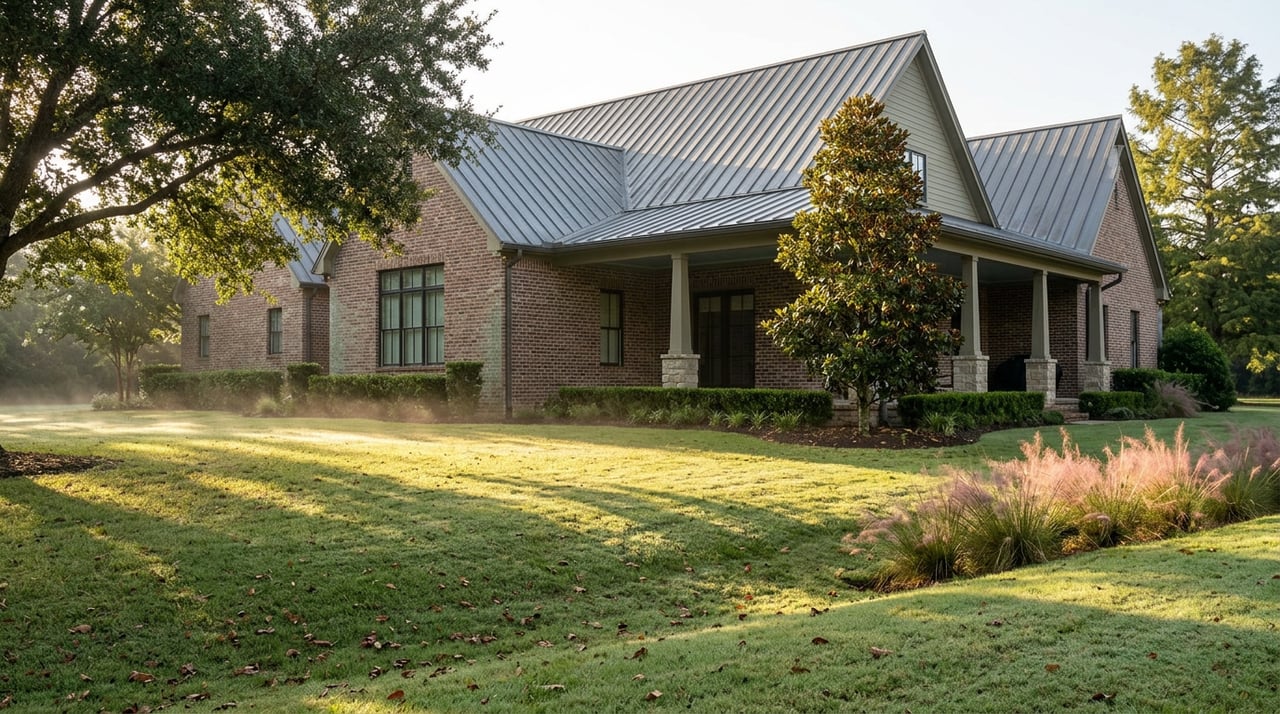
In Ascension Parish, "Septic or Sewer?" Is the Wrong Question to Ask
September 3, 2026
September 3, 2026
"We can't walk out of our homes. It penetrates into our houses, coming up from the drains." That's how a longtime resident of the Preserve at Dutchtown subdivision described her neighborhood last fall, after the small wastewater plant serving her street and the adjoining Old Dutchtown subdivision was found running on one working aerator out of four. The smell wasn't a one-time nuisance. It was a mechanical failure with nowhere to hide, because the plant treating that neighborhood's wastewater sits a few hundred feet from the homes it serves.
Most people shopping for a home in Ascension Parish arrive with a simple mental checklist: is it on septic, or is it on city sewer? In much of Prairieville, Dutchtown, Geismar, and the unincorporated stretches around Gonzales, neither answer is correct. A large share of homes here sit on something in between, a small, privately built "package treatment plant" that serves one subdivision, sometimes one street, and nothing else. Understanding that third category, and the multi-year overhaul currently underway to replace it, matters more to your monthly bill and your due diligence than the septic-or-sewer question you came in asking.
Ascension Parish grew from a rural corridor into one of the fastest-expanding suburbs in the Baton Rouge area over the past two decades, and much of that growth happened outside the city limits of Gonzales and the town of Sorrento, in unincorporated land with no access to a shared municipal sewer main. Developers solved the problem the way builders across unincorporated Louisiana often do: each new subdivision got its own small treatment plant, permitted separately, maintained separately, and discharging treated effluent into the nearest ditch or waterway.
The result, by the time parish officials and National Water Infrastructure finalized their deal in 2024, was more than 75 separate collection systems and roughly 70 to 72 individual neighborhood treatment plants scattered across the parish's east bank. Some of that discharge flowed into Bayou Manchac, a waterway that had come under increasing environmental scrutiny as growth outpaced the aging package plants meant to serve it.
That fragmentation is the reason "septic or sewer" doesn't capture what's actually under most Ascension Parish subdivisions. A package plant is not a septic tank on your own lot, and it is not a connection to a city-run system either. It's a small, shared mechanical facility with a name, an operator, and a maintenance history you can and should ask about.
In April 2021, Ascension Parish voters approved selling the parish government's east bank sewer assets to National Water Infrastructure, a Baton Rouge-based utility that is a portfolio company of Bernhard Capital Partners. The full transaction closed in April 2024, when NWI paid the parish $9.26 million for the system and took on the job of replacing dozens of aging package plants with one centralized facility.
That project, the Ascension Parish Regionalization Project, carries a $185 million price tag and is designed to pull more than 4 million gallons of treated wastewater a day out of local ditches and waterways. As of this summer, NWI expected to select contractors in August and break ground in September, with substantial completion targeted for October 2028.
The plant's location has already moved once. The original site near Louisiana 30 and 73, close to the Stoney Point Estates, Oak Alley, and Legacy Hills neighborhoods, drew organized opposition from residents worried about odor and property values after a town hall meeting in mid-2024. NWI scrapped that location and, by June 2026, settled on a new site along Ashland Road near River Road in Geismar, inside the parish's industrial corridor and, according to the company, more than a mile from the nearest home.
"It meets all the expectations of the community. It allows for a buffer zone."
That's current NWI CEO Myron Lambert describing the new site. It's a telling line, because the first site met engineering requirements too. What sank it was proximity to rooftops, the same variable that will determine which of your neighbors ends up hosting the region's future lift stations and which ones simply get their old package plant decommissioned and returned to green space.
Here's where the story stops being background and starts being math you'll want on hand before you write an offer. Under the parish's old system, residential customers paid a fairly modest fixed rate, historically around $42.50 to $45 a month depending on whether they were parish customers or already NWI customers. In documents filed with the Louisiana Public Service Commission in 2023, NWI proposed an eventual target rate of $84 a month, nearly double the historic figure, to fund construction and operation of the new regional system. NWI's CEO at the time, Tom Pertuit, said in 2024 that the company couldn't start phasing in those increases until infrastructure was actually in the ground, which he expected to begin in 2026.
Commercial customers got there first. In August 2025, NWI shifted business customers off the old flat rate and onto a usage-based tariff approved by the PSC, and some businesses saw their bills rise as a result. Residential rates are structured to follow a similar path once construction is underway, which, based on the timeline NWI has laid out, is happening now.
None of this means a home's wastewater cost is fixed at whatever the seller's last bill shows. It means the number is a snapshot of a system in the middle of a multi-year transition, and the direction of travel is upward.
If you're shopping in Prairieville, Dutchtown, Geismar, or unincorporated land around Gonzales, a little extra homework up front saves a surprise later. Before you get attached to a listing, it's worth finding out:
A seller's disclosure form will tell you whether a home has a private sewerage system. It won't tell you whether that system is one of the ones NWI has flagged for near-term attention, or one that's been running fine for a decade. That distinction lives in parish records, in NWI's own project updates, and sometimes in neighborhood social media groups where residents compare notes on their shared plant. It's worth the extra step.
If your home sits on one of these package plants, get ahead of the conversation rather than waiting for a buyer to bring it up. Pull your last few months of wastewater bills so you can show the current rate in writing. If your subdivision's plant has had any service issues, address them or be ready to explain what's already been done, since word travels fast in smaller subdivisions and a buyer's agent doing their own homework will likely find it anyway. And if you know your neighborhood falls inside NWI's stated early-phase coverage area, that's a point in your favor worth mentioning, since it suggests a nearer-term path to the newer, centralized system.
Does every home in Ascension Parish use a package treatment plant? No. Homes inside the city limits of Gonzales and the town of Sorrento are on those municipalities' own sewer systems. The package plant situation applies to unincorporated areas, which cover a large share of Prairieville, Dutchtown, Geismar, and land around Gonzales.
Will my wastewater bill definitely go up? If your home is served by NWI, higher rates have already been approved in principle by the Louisiana Public Service Commission and are expected to phase in as construction proceeds, following the pattern commercial customers saw in 2025. The exact timing for residential customers depends on how quickly the new regional plant moves from groundbreaking toward completion.
When will the new regional plant actually be finished? NWI is targeting substantial completion in October 2028. The project has already changed sites once due to community pushback, so treat that date as the current plan rather than a certainty.
Ascension Parish is growing fast enough that infrastructure like this rarely stays simple, and that's exactly the kind of local detail we like to walk through with buyers and sellers before it becomes a surprise at the closing table. If you're weighing a move in Prairieville, Dutchtown, Geismar, or anywhere else in the parish, reach out to Debra Sullivan Dream Homes and we'll help you ask the right questions before you write the offer, not after.
Stay up to date on the latest real estate trends.
Experience personalized service, expert guidance, and dedicated support from a team committed to helping you buy or sell with confidence.